Why hands-on cooking is at the heart of what we do at our Bloomfield preschool — and what the research says about it
When parents visit Leonardo da Vinci International Academy and see cooking as one of our core pillars, the reaction is often a warm smile. It feels fun, approachable, a little delicious 😋 What they may not immediately realize is that the decision to make cooking central to our curriculum is not only about fun. It is grounded in decades of research in early childhood development, cognitive science, and neuroscience!
Let’s dive into this, because we believe parents in Bloomfield, Glen Ridge, and Montclair deserve to understand the why behind what happens in our classrooms every day.
What the research actually says
A landmark study published in the Journal of Nutrition Education and Behavior (Chu, 2003) found that children who participate in hands-on cooking activities show significantly greater willingness to try new foods, stronger fine motor development, and measurably higher engagement in structured learning tasks. The effect was most pronounced in children ages 3 to 5 — precisely the preschool window 🎒
This is not an isolated finding. The Harvard Center on the Developing Child has extensively documented that “executive function” skills — the ability to plan, focus, remember instructions, and manage impulses — develop most rapidly between ages 3 and 6, and that they are best built through structured hands-on activities that require sequencing, patience, and decision-making. Cooking is, in that sense, one of the most complete executive function exercises that exists for a young child.
“Children learn by doing, not by being told.”– Jean Piaget, developmental psychologist and pioneer of constructivist learning theory
Jean Piaget’s framework, now foundational to early childhood education worldwide, holds that children build knowledge by physically interacting with their environment — touching, transforming, observing cause and effect. A kitchen is, quite literally, a constructivist classroom.
Five developmental domains that cooking activates simultaneously
What makes cooking so powerful as a preschool learning activity is that it does not target one skill. It activates multiple developmental domains at the same time — which is exactly how young brains learn best.
1. Mathematics — in context, not in the abstract
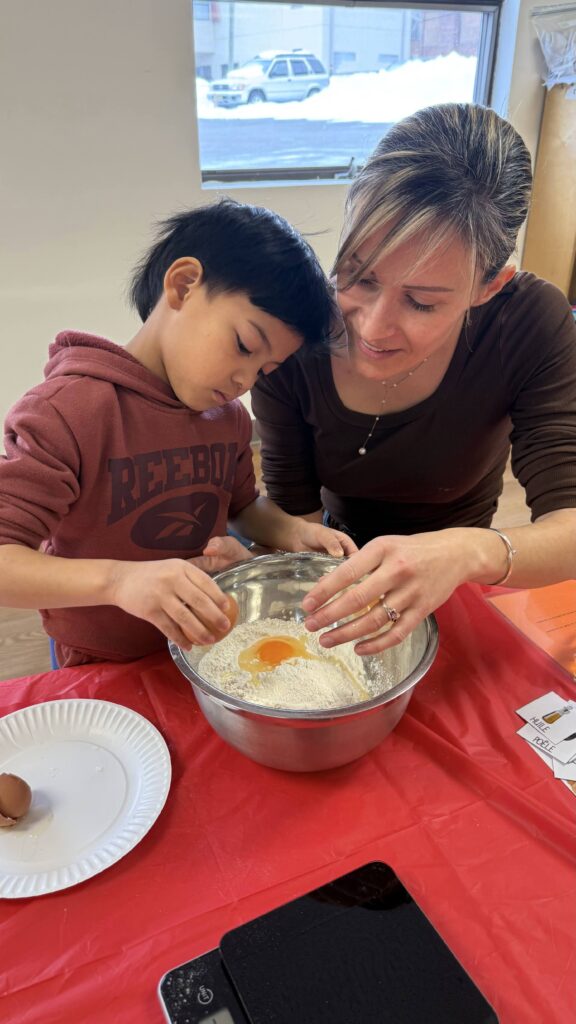
Measuring cups and spoons introduce volume, fractions, and comparison (“more than,” “less than,” “equal to”) in a fully concrete way. Counting eggs, dividing dough, observing that two halves make a whole — these are not math exercises disguised as cooking. They are math, happening naturally. Research from the National Council of Teachers of Mathematics (NCTM) confirms that early exposure to mathematical concepts through real-world, embodied activities produces stronger long-term numeracy outcomes than abstract instruction.
2. Science — cause, effect, and transformation
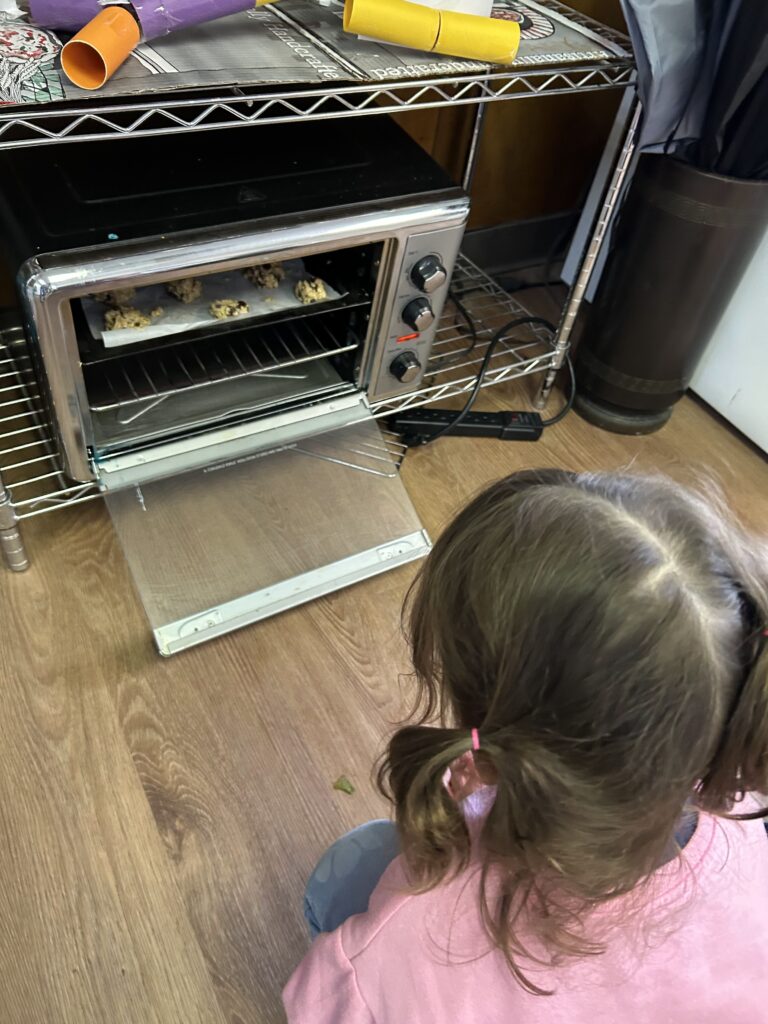
What happens when you add heat to butter? Why does dough rise? How does liquid become solid in the freezer? These are chemistry and physics questions — asked and answered at age four, through direct observation. The National Association for the Education of Young Children (NAEYC) identifies this type of “inquiry-based sensory experience” as one of the most effective pathways into scientific thinking for young children. Cooking provides it every single session.
3. Fine motor development — precision with purpose
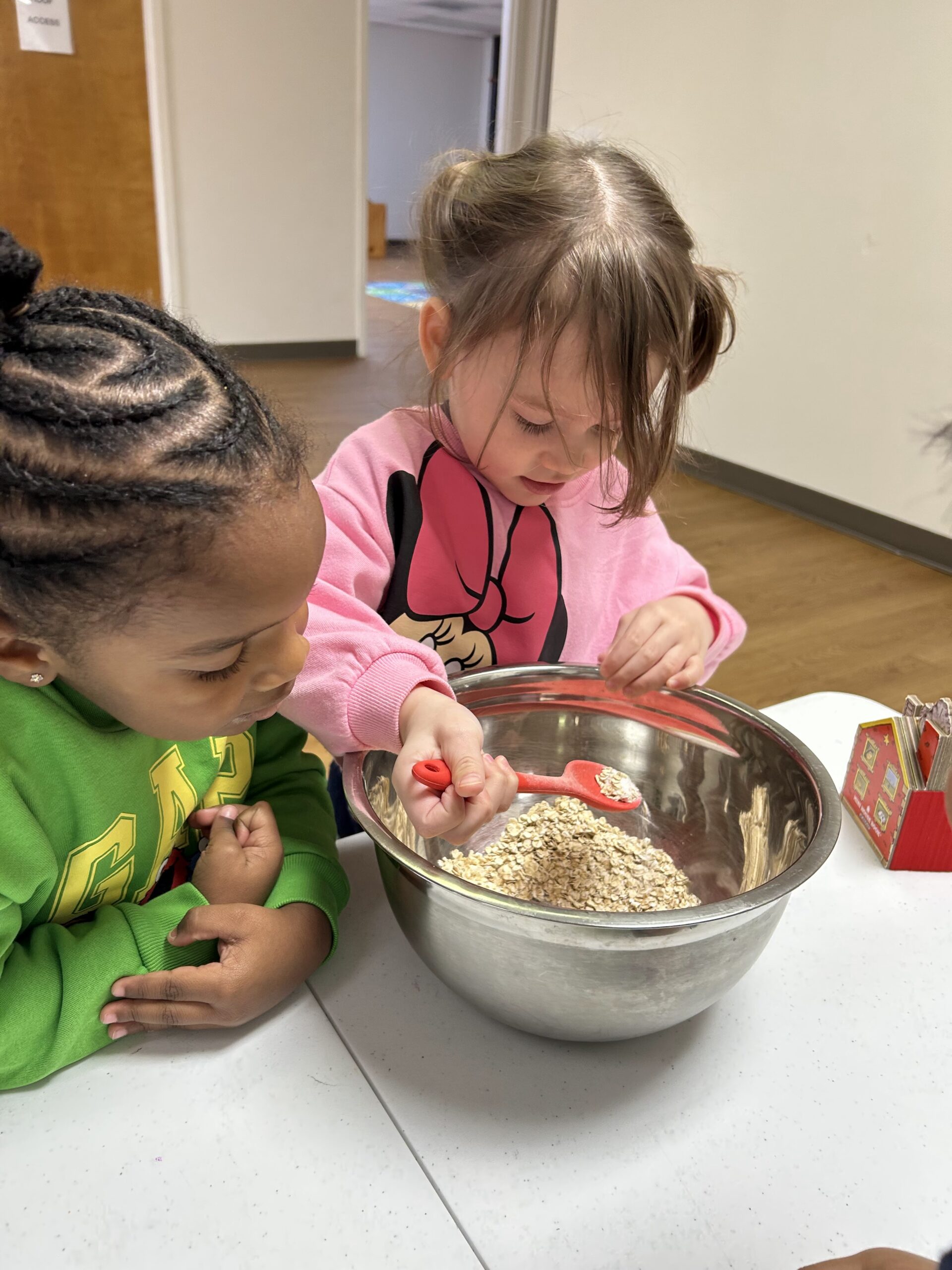
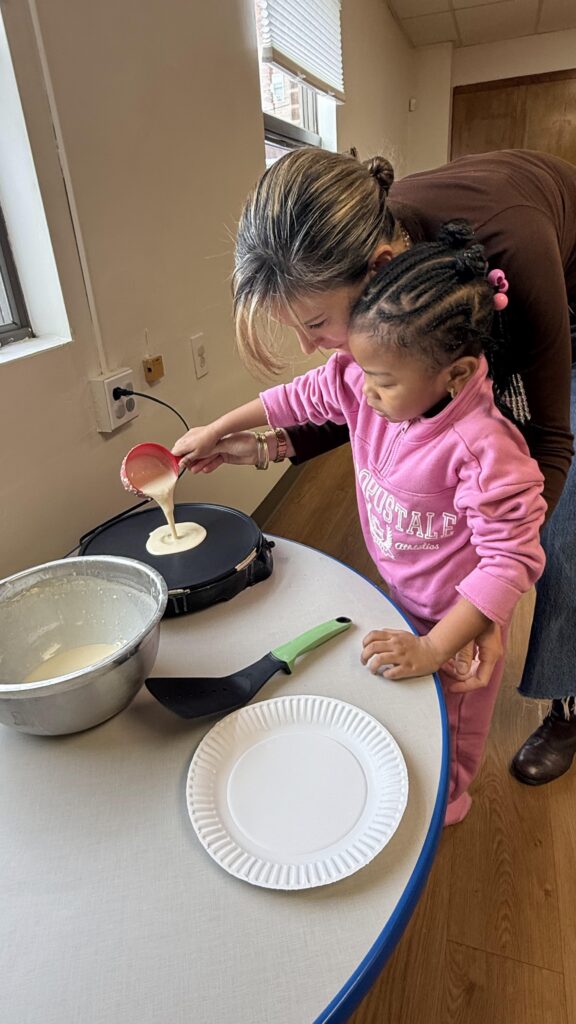
Pouring, stirring, kneading, spreading, cutting with a child-safe knife — these actions require and develop the fine motor control that underpins handwriting, drawing, and tool use. Unlike worksheets or tracing exercises, cooking provides a purpose for the movement, which dramatically increases engagement and retention. A study from the American Journal of Occupational Therapy found that children who regularly engage in food preparation activities demonstrate faster development of pincer grip and bimanual coordination than peers who do not.
4. Language and literacy — sequencing, vocabulary, narration
Following a recipe is a sequencing task. “First we do this, then we do that, finally we see this result” is the same narrative structure as a story. Cooking naturally builds the vocabulary of process (before, after, meanwhile, until), the vocabulary of description (smooth, lumpy, golden, fragrant), and the habit of paying close attention to instructions — all of which are foundational literacy skills. For children in our World Languages program, naming ingredients and actions in Spanish, French, or Mandarin during cooking activities creates some of the richest language acquisition moments of the school day.
5. Confidence, autonomy, and emotional regulation
Perhaps the most underappreciated benefit of cooking with young children is what it does for their sense of self 🌟 When a three-year-old makes something that a grown-up then eats and enjoys, something significant happens in their development. They experience themselves as capable, as contributors, as people whose actions have real and valued consequences. The Harvard Center on the Developing Child links this kind of “agency experience” directly to the development of resilience and self-regulation — the emotional foundations that predict school readiness far more reliably than academic knowledge.
Why most preschools don’t do this — and why we do
Cooking with young children requires more preparation, more supervision, more cleaning, and more tolerance for mess than almost any other classroom activity. It is logistically demanding. It is easier not to do it.
At Leonardo da Vinci International Academy, we do it anyway — regularly, intentionally, and as a core pillar of our curriculum — because the developmental return on that investment is simply too significant to ignore. Our certified preschool teachers and certified early childhood professionals are trained not just to run a recipe, but to facilitate the learning that happens around it: asking the right questions, introducing the right vocabulary, letting children lead where possible, and guiding the science conversation that emerges naturally from every transformation they observe.
This is what we mean by “Cooking Up Creativity.” Not a cute name for baking cookies. A deliberate, research-backed approach to early childhood development that happens to smell wonderful.
What this looks like at our Bloomfield preschool
In our classrooms, cooking activities are woven into the broader curriculum. A session might begin with a read-aloud about a garden, move into planting herbs in our outdoor education space, and conclude with a cooking activity using those same ingredients — connecting literacy, science, outdoor education, and fine motor development in a single morning. Our World Languages pillar means children might learn the names of ingredients in three languages before they have finished making their snack.
The result is not just a child who knows how to stir batter. It is a child who has practiced patience, followed multi-step instructions, asked a scientific question and listened to the answer, expanded their vocabulary in multiple languages, and experienced the deep satisfaction of making something real. All before lunchtime.



Is your child ready to become a little chef — and a little scientist, mathematician, and storyteller along the way?
Every child is. The kitchen has always been one of humanity’s greatest classrooms. The role of a great preschool is to bring that learning intentionally into every session, every ingredient, every moment of discovery.
If you are looking for a licensed preschool in Bloomfield, Glen Ridge, or Montclair where cooking — and every other pillar of our curriculum — is grounded in research and woven into daily life, we would love to show you what that looks like in person. Visit ldvacademy.com or call us to schedule a tour.
About Leonardo da Vinci International Academy
We are a warm, non-denominational licensed preschool and childcare center in Bloomfield, NJ, welcoming children ages 2.5 through Kindergarten and serving families in Bloomfield, Glen Ridge, and Montclair. Our school is a New Jersey Department of Children and Families licensed preschool and daycare, led by certified early childhood professionals in a safe and nurturing learning environment. We offer preschool, extended care from 7:30 AM to 6:00 PM, and enrichment programs built on our core pillars: Music & Movement, World Languages, STEAM exploration, Cooking Up Creativity, and Outdoor Education.