Why Music & Movement is a core pillar at our licensed preschool in Bloomfield, NJ — and what the research says.
Walk into almost any preschool and you will hear music at some point during the day. A cleanup song, a counting rhyme, a little movement break between activities. Music is so common in early childhood settings that it can start to feel like wallpaper — pleasant background, nothing more.
At Leonardo, we have always believed that music belongs at the heart of a child’s day — not as a fun break between the “real” learning, but as one of the most powerful learning tools we have. Music & Movement is one of our five core curriculum pillars, woven into daily life for every child in our Bloomfield classroom. And the more we learn from early childhood research, the more certain we are that this is exactly right. Let’s have a look at it in more detail.
What happens in a child’s brain when they engage with music
Music is one of the most neurologically complex activities a human brain can engage in. It simultaneously activates areas responsible for auditory processing, motor control, language, memory, and emotion. For a developing brain, that simultaneous activation is not just interesting — it is transformative.
Nina Kraus, neuroscientist at Northwestern University and founder of the Harmony Project, has spent two decades documenting how active musical engagement strengthens the brain’s auditory processing system — the same system that underlies reading and language acquisition. Her research shows that children who participate regularly in music programs develop stronger phonological awareness, better working memory, and faster neural processing of sound. These are not musical skills. They are foundational academic skills.
“Music gives wings to the mind, flight to the imagination, and life to everything.”— Plato, philosopher (Laws, Book II)
Plato was not speaking metaphorically. Modern neuroscience has given us the tools to understand what he may have intuited: music restructures the developing brain in ways that benefit nearly every domain of learning… and it’s such good news for our little music lovers 🎶
Five developmental benefits that music activates every day
1. Language and early literacy
Songs, rhymes, and chants are among the most powerful tools for early language development. They expose children to rhythm, repetition, and phonemic patterns — the building blocks of reading. A landmark study from McMaster University (Trainor et al., 2012) found that toddlers who participated in active musical classes showed earlier and stronger development of communication skills, including gesture and language, compared to peers in passive music exposure groups. At our preschool, singing is never just singing — it is phonics in disguise.
2. Mathematical thinking
Music is mathematics made audible. Beat, rhythm, and meter introduce children to patterns, counting, fractions, and sequences in a way that is felt before it is understood analytically. Research published in the Journal of Educational Psychology has consistently found correlations between early musical training and stronger mathematical reasoning — not because music teaches math directly, but because both disciplines rely on the same underlying cognitive structures: pattern recognition, sequencing, and symbolic thinking.
3. Gross motor development and body awareness
Movement is inseparable from music at this age, which is precisely why our pillar is called Music & Movement rather than music alone. Clapping, stomping, dancing, and keeping a beat all develop coordination, laterality, and body awareness — the physical foundations that support writing, sports, and spatial reasoning later in life. For our certified preschool teachers, a movement session is also a window into each child’s physical development, allowing them to identify and support any areas that need attention in a joyful, pressure-free context.
4. Emotional regulation and social connection
Music is one of the oldest tools humans have used to regulate emotional states and build community. For preschoolers, who are still developing the neurological capacity to manage big feelings, music offers a structured, non-verbal pathway to self-regulation. The Harvard Medical School Music & Health Research Collaboratory has documented how group musical activities reduce cortisol levels in young children and strengthen prosocial behaviors — cooperation, turn-taking, empathy — far more effectively than many traditional social-emotional learning exercises. When children sing together, they are also learning to listen to each other.
5. Memory, attention, and executive function
Learning a song requires memory. Keeping a beat requires sustained attention. Following the structure of a musical game requires impulse control and flexibility. These are all executive function skills — and as the Harvard Center on the Developing Child has shown, executive function is the single strongest predictor of long-term academic and life success, more reliable even than IQ. Music trains these skills daily, joyfully, and without a single worksheet.
What this looks like at our Bloomfield preschool
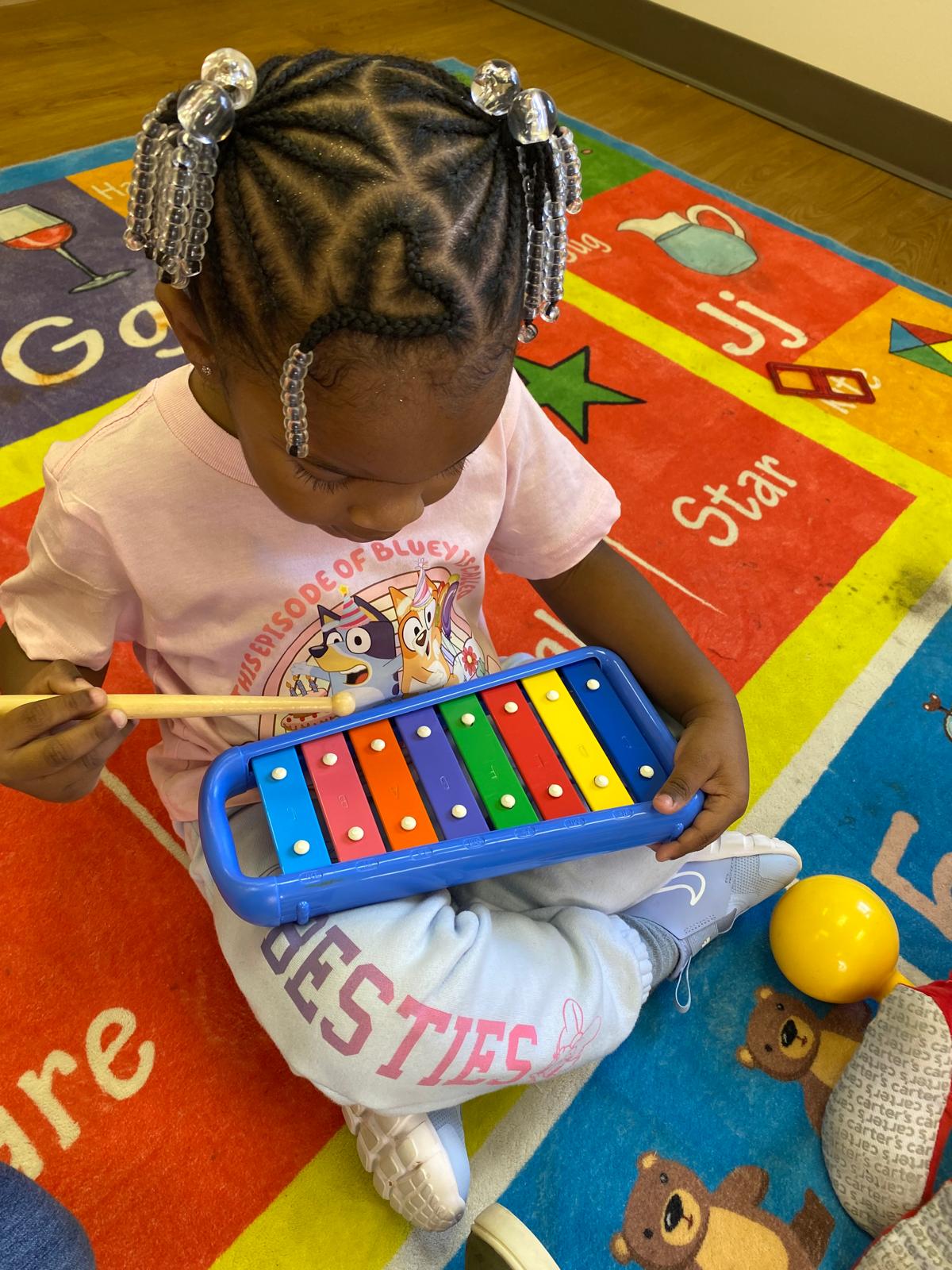
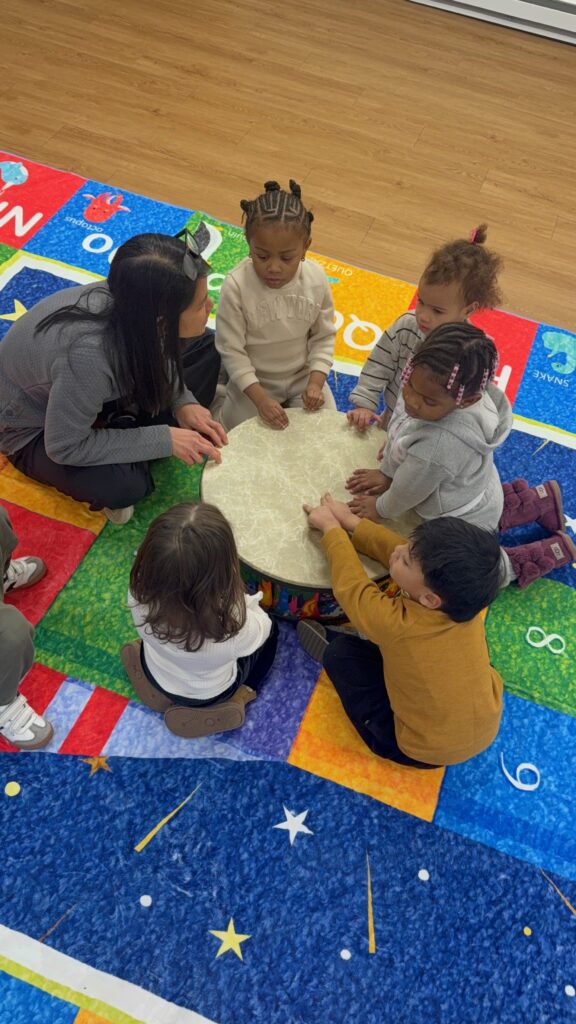
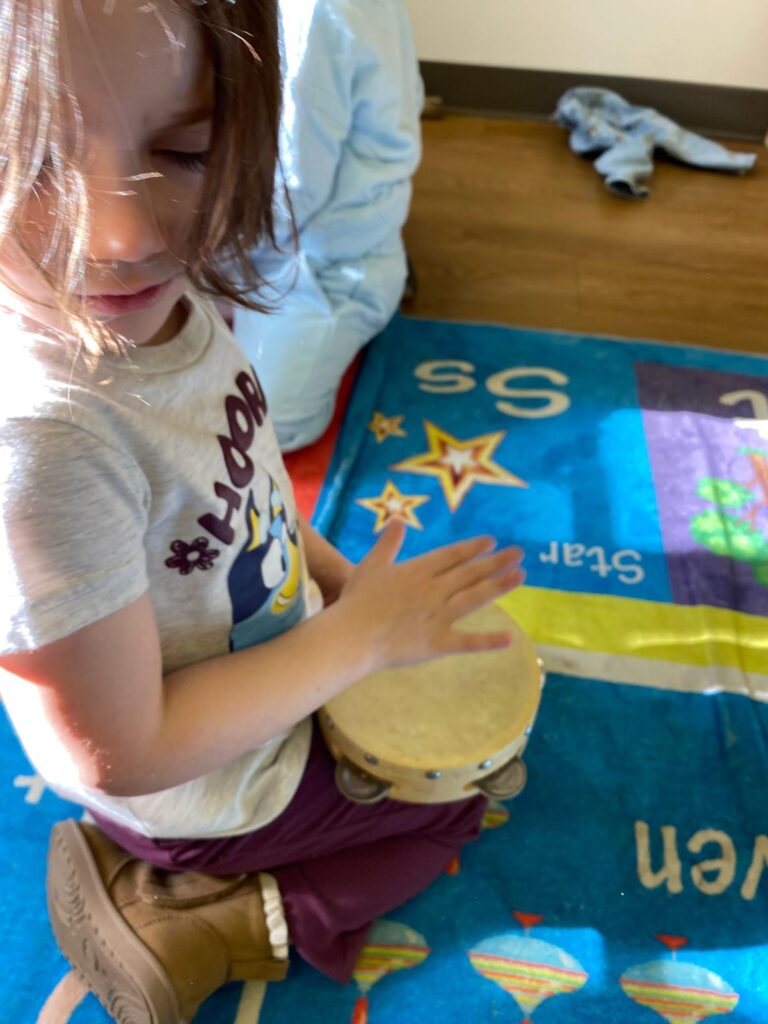
If you could peek into our classrooms on any given morning, here is what you might see: Miss Miki sitting cross-legged on the rug, a hand drum in the center of the circle, four little pairs of hands finding the beat alongside hers. Miss Camille guiding a group of toddlers through a rhythm game with wooden sticks — not because it is music time, but because it is transition time, and this is how she brings everyone back together. Miss M. holding a tambourine at eye level with a child who is just finding her confidence, waiting patiently for the moment she reaches out. Miss T. watching quietly as two children negotiate who gets the xylophone next — letting the social learning happen, knowing when to step in and when to step back.
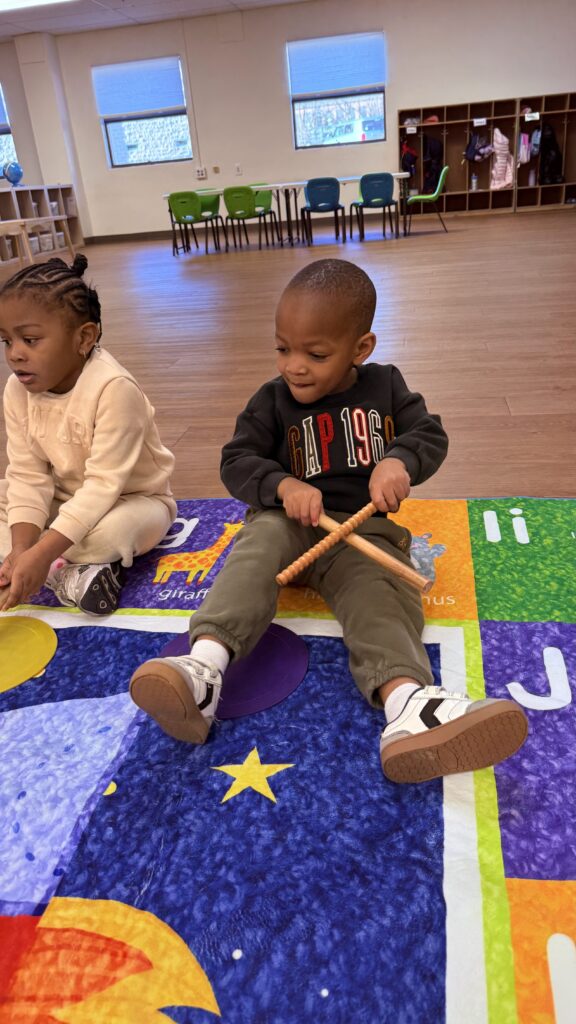
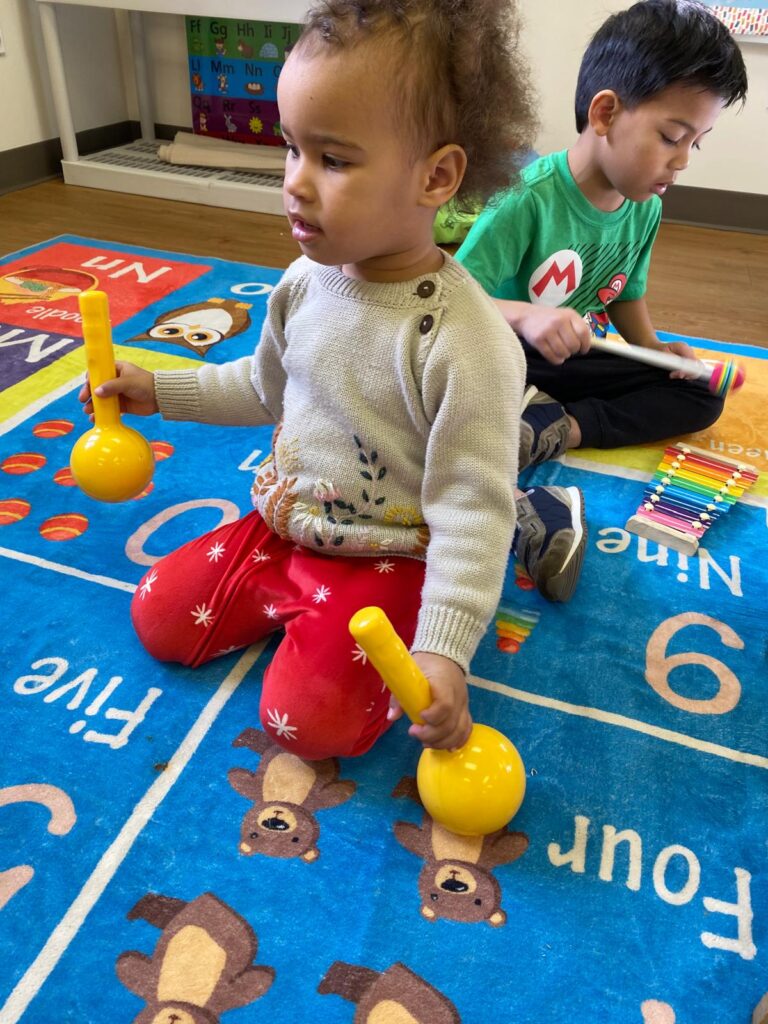
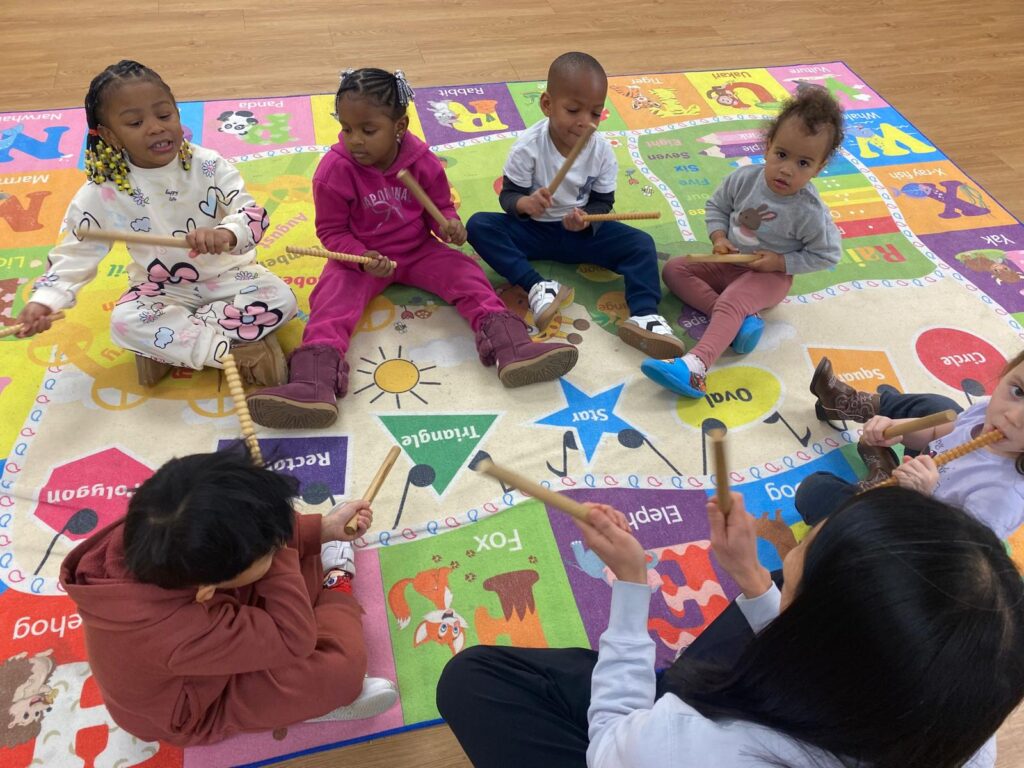
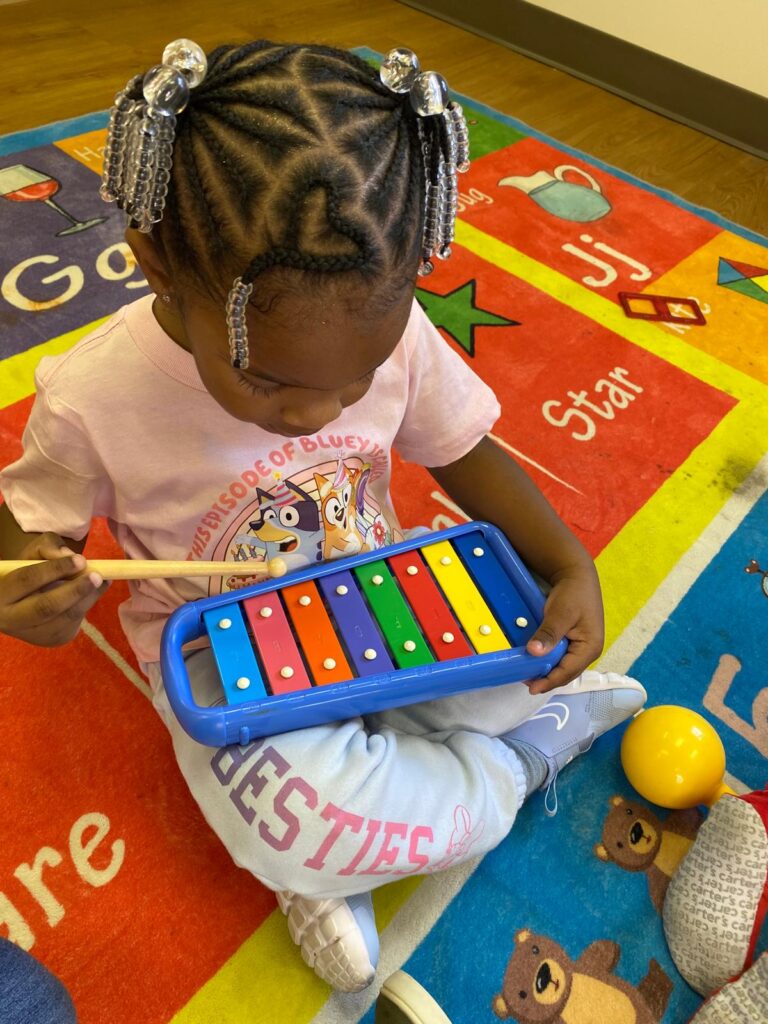
None of this looks like a performance. None of it is. Our teachers understand that music at this age is not about producing little musicians — it is about giving children a language for rhythm, attention, feeling, and connection that words alone cannot yet provide. It is one of the reasons children who are shy in other settings come alive during Music & Movement. And it is one of the reasons families from Bloomfield, Glen Ridge, and Montclair trust our safe and nurturing learning environment with the most important people in their lives.
Is your child ready to learn through music, movement, and so much more?
Every child is born with a response to rhythm and melody — it is one of the most universal human traits we know of. The role of a great preschool is to meet children there, and build from it 😉
If you are looking for a licensed preschool in the Bloomfield, Glen Ridge, or Montclair area where Music & Movement is woven into daily learning — not treated as a break from it — we would love to show you what that looks like in person. Look into our curriculum here or call us to schedule a tour (973) 533-8312.
About Leonardo da Vinci International Academy
We are a warm, non-denominational licensed preschool and childcare center in Bloomfield, NJ, welcoming children ages 2.5 through Kindergarten and serving families in Bloomfield, Glen Ridge, and Montclair. Our school is a New Jersey Department of Children and Families licensed preschool and daycare, led by certified early childhood professionals in a safe and nurturing learning environment. We offer preschool, extended care from 7:30 AM to 6:00 PM, and enrichment programs built on our core pillars: Music & Movement, World Languages, STEAM exploration, Cooking Up Creativity, and Outdoor Education.